Google Maps SEO: Why the Map Comes First for Local Businesses
The first thing your customers see on Google is often the last thing most SEO companies focus on.
What is Google Maps SEO?
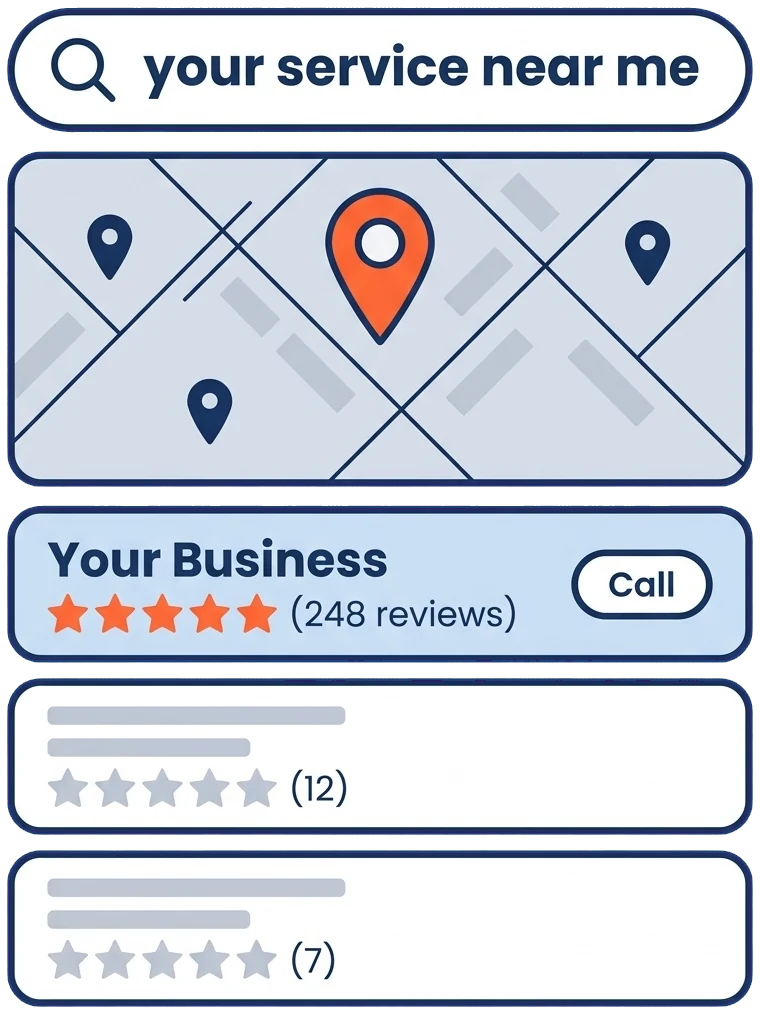
Google Maps SEO is how you get your business into those top three map spots—the first thing people see when they search for a local service. Since 2015, only three businesses make the cut. The #1 map spot now draws about twice as many clicks as the top regular result, even as AI answers take more space. That’s why we start with the map and build your machine to support it.
- What does a local search look like today?
- Why does the map matter more than regular results?
- What changed in 2015?
- Is the map pack holding up against AI answers?
- What happens if you’re not in the top three?
- How does Google decide who shows up on the map?
- Does my website still matter?
- Why do most SEO companies sell website rankings first?
- How do I rank higher on Google Maps?
- Frequently asked questions
What does a local search look like today?
Search for a local service on Google, like “electrician near me” or “accountant in Derry NH,” and you’ll usually see three things, top to bottom:
- Sometimes an AI answer at the very top.
- The map, with three businesses listed. This is the “map pack.”
- The regular results: a list of websites.
Most SEO companies focus on the regular results. We focus on the map, where your customers actually click.
Why does the Google map matter more than regular results for a local business?
Because that’s where local customers click. In 2026 click data, the #1 map spot got 14.8% of clicks, while the #1 regular result got 7.1%: about twice as many for the map. Map spots #2 and #3 got 12.6% and 11.9%.
Source: First Page Sage, “Google Click-Through Rates (CTRs) by Ranking Position in 2026” (1,184 websites, 3.67 billion search impressions, March–August 2026).
An older user study found the same pattern from a different angle: about 4 in 10 local searchers clicked a map result.
Source: Backlinko user behavior study, 2020 (259 people, 1,801 searches).
The map lets people take action right away—call, get directions, or read your reviews—without ever visiting your website.
14.8%
the #1 map spot
7.1%
the #1 regular result
What changed in 2015?
On August 6, 2015, Google cut the map list from seven businesses to three, in every industry and every country, in less than a day. Since then, only three businesses get the spots people see first.
Source: Moz, “Google’s Local Snack Pack Shake-Up: What You Need to Know,” August 2015.
That change made the map a race for just three spots. Landing in fourth place is a world away from being third.
2015
Google cut the map list from seven businesses to three
Is the map pack holding up against AI answers?
Yes. It’s holding up far better than the regular results. Over one year, clicks on the #1 map spot fell 16% (from 17.6% to 14.8%). Clicks on the #1 regular result fell 82% (from 39.8% to 7.1%), as AI answers at the top of the page answered questions people used to click for.
First Page Sage calls the #1 map spot “the most resilient organic surface on Google.”
Source: First Page Sage, Google CTRs by ranking position, 2026.
When regular results lose ground, any SEO plan built just on website rankings loses ground too.
When people need someone nearby, the map is still where they decide.
What happens if you're not in the top three?
You miss out on most of the attention. Businesses in the top three map spots get more than double the search traffic and nearly twice as many calls, direction requests, and website clicks as those ranked below.
Source: SOCi, Localized Marketing Benchmark Report, April 2022 (12.9 billion data points, multi-location brands).
If you’re in spot four or lower, you’re hidden behind a ‘More places’ link. That’s why being third matters so much more than being fourth.
Third place gets the call. Fourth place gets scrolled past.
How does Google decide who shows up on the map?
Google says map results are based mainly on three things:
how well your business profile matches what someone searched.
how far your business is from the person searching.
how well known your business is. Google says this includes “how many websites link to your business and how many reviews you have.”
Google also says “more reviews and positive ratings can help your business’s local ranking,” and “there’s no way to request or pay for a better local ranking.”
Source: Google Business Profile Help, “Tips to improve your local ranking on Google.”
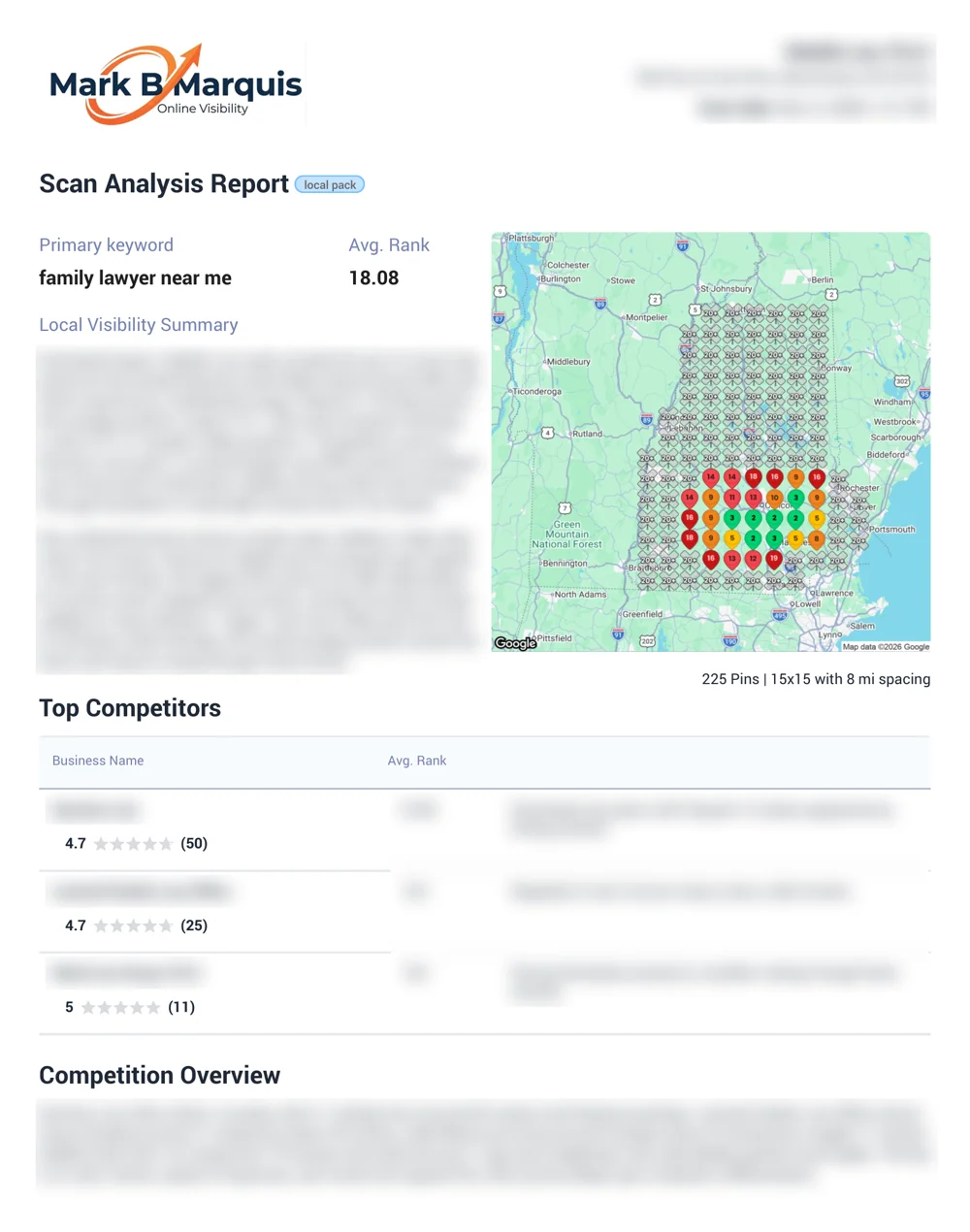
Distance is the factor most business owners overlook. You might show up first when searching from your office, but disappear just a couple miles away. That’s why checking from your desk doesn’t tell the whole story—and why we scan your entire town.
Does my website still matter?
Yes, and here’s the honest answer: your website matters in two key ways.
Sources: Google Business Profile Help; Near Media, “Local SEO Theory & Praxis,” 2023.
So the answer isn’t “the website doesn’t matter.” It’s map first, with a machine built to feed it and win the rest. That’s why we build both, in that order.
- It feeds the map. Google counts links to your website toward your prominence, and your site is where you back up what your profile says: your services, your towns, your proof.
- It wins the people who scroll past. In some industries, regular results still get more total clicks. In a 2023 study of legal searches, regular results got 55.8% of clicks, and Google profiles got 27.6%.
Why do most SEO companies still sell website rankings first?
Mostly because that’s how SEO has always been sold, and it’s what most companies know. Website rankings used to be the whole game before the map took over the top of the page. Many SEO packages haven’t changed since then.
The facts above changed the order. For local businesses, customers look at the map first. It’s holding strong while regular results lose clicks, and it’s won by rules that website work alone can’t cover.
| Feature | Typical SEO package | Our map-first plan |
|---|---|---|
| Starts with a visibility scan of your whole town | — | ✓ |
| Works on your Google Business Profile first | ~ | ✓ |
| Builds your reviews | ~ | ✓ |
| Builds your website to feed the map | — | ✓ |
| Tracks your map spot across your town | — | ✓ |
| Works on your website’s regular rankings | ✓ | ✓ |
| You own your website | ~ | ✓ |
✓ = included · ~ = sometimes · — = usually not
If you’ve paid for SEO before and never moved up on the map, this could be why. It’s not your fault—most companies never showed you the map.
Not sure? Start with a free visibility report
Get Your Free Visibility ReportHow do I rank higher on Google Maps?
You work on the three things Google says it uses, in the right order for your business:
the right categories, services, and description on your Google Business Profile, matched by pages on your website.
a steady flow of real reviews, replies to them, and a website other sites link to.
you can’t move your office, but a strong profile and website can expand your reach over time.
The order matters, and it’s different for every business. That’s why we always start by taking a close look.
How do I know where I show up now?
With a visibility scan. It shows exactly where your business appears on Google Maps from different spots around your town, and who’s ahead of you at each one.
Step one with us is always a free visibility report. We don’t make a move until we see your challenges the way your customers do. That scan becomes the strategy to get you into the top three.
Why is it free? Our visibility reports show us exactly what you need. The technology costs us, but we wouldn’t do the work right without it.
You can’t fix what you can’t see.
Key takeaways
- Since 2015, only three businesses get Google’s top map spots.
- The #1 map spot gets about twice the clicks of the #1 regular result, and it’s holding up as AI answers grow (First Page Sage, 2026).
- Fourth costs far more than third (SOCi, 2022).
- Your website still matters: it feeds the map and wins the rest.
- Map first, with your website feeding it. Step one is always a free visibility report.
Frequently asked questions
What is the Google map pack?
It’s the map with three businesses that Google shows near the top of a local search. Since August 2015, it has shown three businesses instead of seven. Everyone else is behind a “More places” link.
Is Google Maps SEO different from regular SEO?
Yes. Regular SEO works on your website’s place in the list of websites. Google Maps SEO works on your place on the map, which Google ranks on relevance, distance, and prominence. Your website helps both, but the map has its own rules.
Why is my New Hampshire business not showing up on Google Maps?
Common causes include the wrong categories, a duplicate or unverified profile, too few reviews, a website that doesn’t support your profile, or distance from the searcher. A visibility scan shows which one is holding you back, and where.
Can you guarantee I'll be in the top three?
No one honestly can. Google says there’s no way to pay for a better local ranking. What we can do is show you exactly where you stand today, and where you’ve moved on every re-scan.
Do I still need a website if the map matters more?
Yes. Google counts links to your website toward your map ranking, and your site wins the customers who scroll past the map. We build it to feed the map first.
How long does it take to move up on the map?
It depends on where you start and how competitive your area is. Some fixes show up quickly; growing your reach into the next town takes steady work. Your re-scans show you the progress.
See exactly where you show up on the map, spot by spot.
Curious how your business shows up locally? Get a free visibility report tailored to your town. No strings attached.